Case Study: Renewables In-House Training Services Building Internal Capability for Sustainable Energy Projects
Background on Case Study Renewables In-House
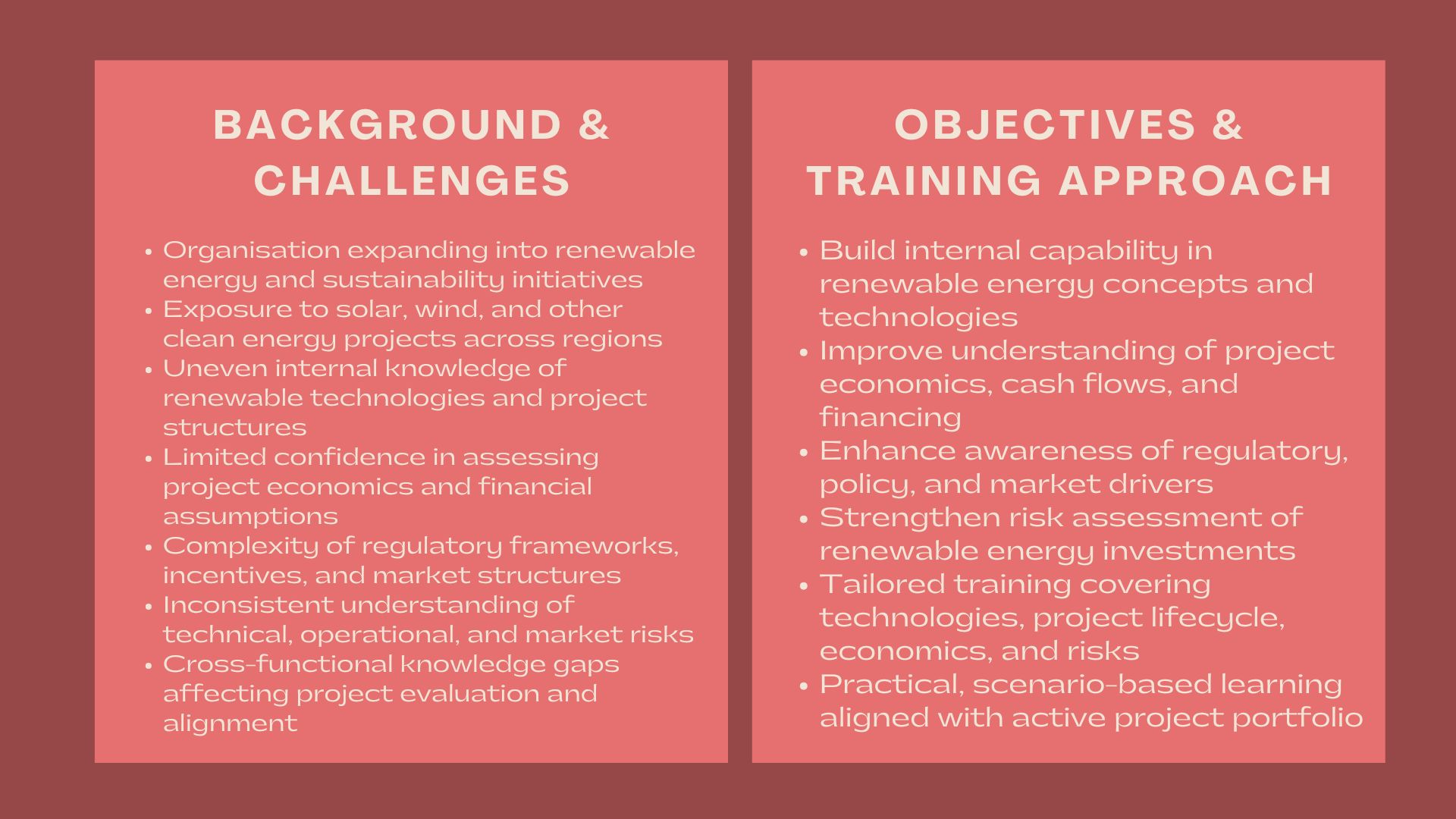
Its interest in renewable energy and sustainability was a growing organisation, and it was expanding its engagement in the clean energy activities. The organisation was pursuing and developing renewable energy ventures in various regions (including solar, wind and other sustainable infrastructures) as direct investments, joint ventures or as part of its overall decarbonisation and sustainability plan.
With renewable energy projects progressively forming an important part of the organisation’s activities and long term planning, the management realised that it was high time to reinforce internal knowledge regarding the basis of renewable energy. Finance teams, strategy, investment, operations and sustainability teams had to review more and more renewable projects, risk analysis, and involvement in the process of deciding.
Nevertheless, there was a wide range of internal expertise in renewable energy ideas, project finance, regulatory aspects and market forces across groups. As a way of developing a consistent and viable insight into renewables, the organisation sought the services of our Renewables In-House Training Services to develop and implement a specific training programme that is in line with its business goals and project portfolio.
Issues and Challenges
Some of the issues that the organisation experienced led to the necessity of organised training on renewables interests.
Poor knowledge of the basics of renewable energy was one of the challenges. Some of the team members had previous experience of clean energy projects, but others were unconversant with such fundamental concepts as capacity factors, power purchase agreements, grid connection issues, and lifetime costs.
The other issue was the assessment of financial and commercial characteristics of renewable projects. External consultants tended to provide significant advice to teams on project economics, assumptions and risks and denied internal confidence as well as delaying the process of decision-making.
The complexity of regulatory and policies was also a problem. Changing regulations, incentives and market structures affect renewable energy projects and internal stakeholders require a better understanding of the implications of these factors on the viability and payback returns of the projects.
The other area of concern was risk assessment. The management desired teams to have a better insight into technical, operation, market, and counterparty risk inherent in renewable energy investments and their differences with traditional assets.
Lastly, the organisation sought to enhance cross-functional working. Projects dealing with renewable projects needed input in the form of finance, legal, operations and sustainability departments and the levels of knowledge were sometimes divergent, thus creating barriers to effective communication and alignment.
Objectives
The main aim of the engagement was to develop internal power of renewable energy by having tailored renewable energy in-house training.
Particularly, the organisation was to:
- Enhance the knowledge on renewable energy technologies and project structures.
- Increase the understanding of renewable projects economics and drivers of cash flows.
- Increase regulatory, policy and market awareness.
- Informed assessment of risks and opportunities of renewable energy is supported.
- Develop a team-based renewable energy expertise.
The training must have been realistic, friendly to non-specialists and was to correspond with the renewable energy strategy of the organisation.
How We Helped
We engaged in a systematic and participative way of in-house training on renewables, and this was based on the industry background, project experience and internal decision-making requirements of the organisation.
The first way we were involved was through renewables training needs assessment. We consulted with senior management and other key stakeholders to get a sense of what the organisation aims to achieve in renewable energy, the existing and upcoming projects and what are the challenges facing teams when considering the renewable opportunities.
On this evaluation, we have structured tailor-made training modules on the major renewable energy issues. These were a brief summary of renewable energy technologies, stages of project development, the project structure and the role of stakeholders.
We also touched upon the economics of renewable projects and gave participants a tour of the revenue models, the cost structures, financing issues, and other key assumptions that will determine whether a project will be viable. Diffusion of concepts was well explained to facilitate understanding among the participants who may have varying technical backgrounds.
Regulatory and policy factors were integrated to the training so that the participants can be aware of the impact of incentives, tariffs and regulatory regimes on the outcome of renewable projects. Risk identification and risk management were also addressed with the attention to practical considerations, which are applicable to the projects of the organisation.
Practical application was given a high priority. Nowhere in the training were real-world examples or simplified project situations and interactive discussions offered, which were practical scenarios of making decisions using renewable energy. The participants were also urged to match ideas with their roles and duties.
The training programme was designed to include the participants, who represent the various functions, such as the functions of finance, investment, sustainability, operations, and management. This helped to make it accessible and created a shared idea of renewable energy in the organisation.
The delivery of training was flexible and involved both on-site training workshops and online training to support the operations. Participatory dialogue, scenario analysis and question and answer were employed to promote involvement and understanding.
As reinforcement, we offered supporting materials and reference guides that could be used by the participants following the training in order to substantiate the further discussions and project reviews.
During the interaction, we endeavored to guide the participants to understand the concepts and answer queries, and tailor the content to the unique renewable energy environment of the organisation.
Value Delivered
In this case study, the author shows how internal capability can be enhanced by professional Renewables In-House Training Services to inform participation in renewable energy initiatives.
The engagement, through tailored and work-focused training, contributed to the internal confidence in grasping renewable energy initiatives, the enhancement of the cross-functional communication, and the evaluation of the renewable opportunities more effectively.
The in-house training system that was established as a result of this engagement created a scalable base of continuous capability development, a more robust system of governance, and an improved comprehension of clean energy initiatives and sustainability initiatives.