
Alternative Investments Training: Hedge Funds, Private Debt, and Real Assets
Introduction to Certified Alternative Investments Training
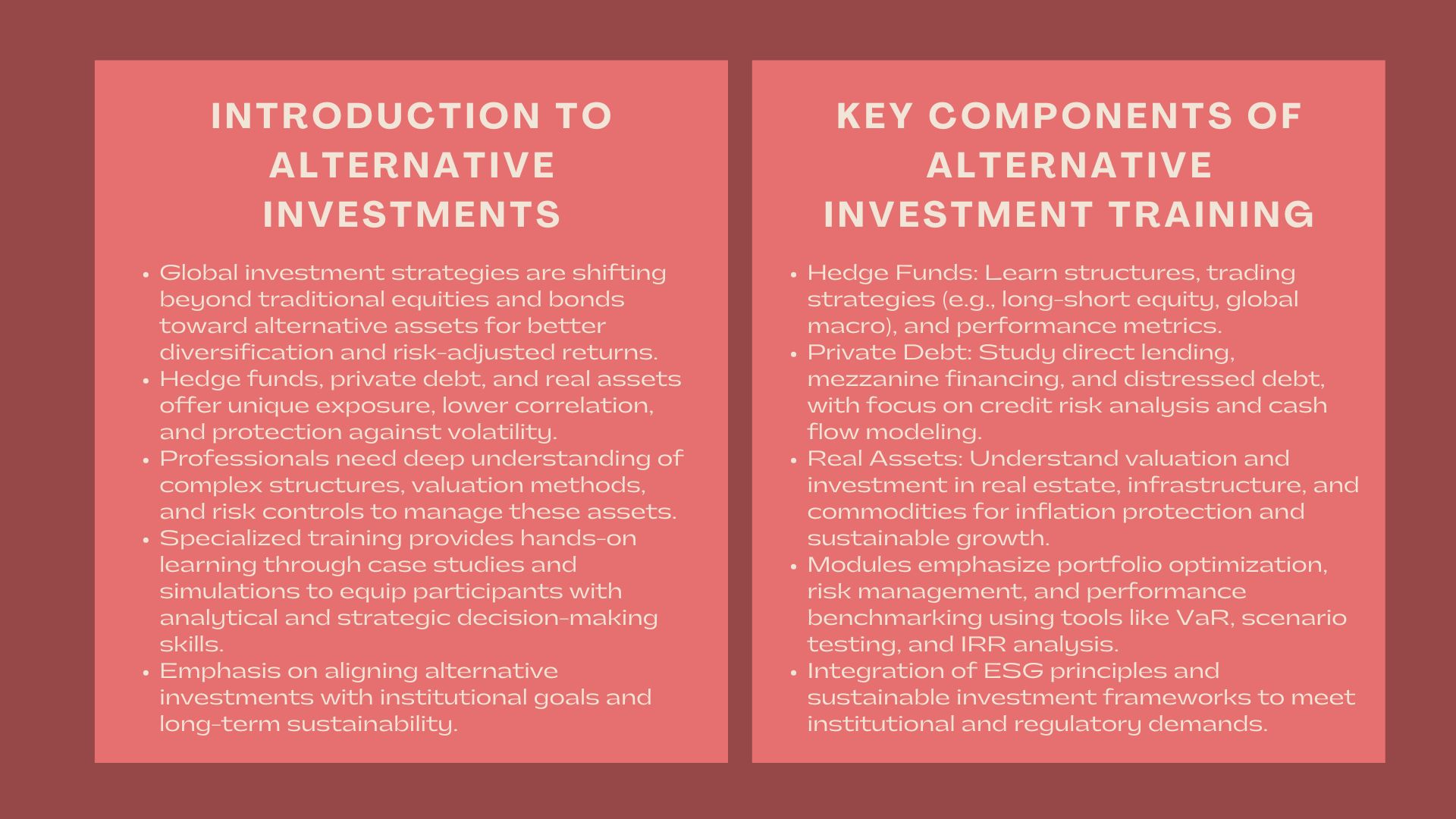
In a fast changing world of global investments, diversification is no longer a luxury to institutional investors and portfolio managers, since the focus has shifted to other investment options other than equities and bonds. Alternative investments (hedge funds, private debt, and real assets) present a chance to get greater risk-adjusted returns, protection against volatility, and an uncorrelated asset allocation. Nevertheless, these tools demand a profound knowledge of complicated structures, valuation methods, and risk control measures as well.
Alternative investments are being trained in specialized programs to provide the knowledge to the professionals in the financial field on the necessary skills in terms of analyzing, structuring, and managing these complex portfolios. With the help of real-life exercises, case studies, and information-oriented learning, participants get to know how to maneuver through the mazes of non-traditional investments and synchronize them with institutional goals.
The Growing Role of Alternative Investments.
In addition to the Traditional Asset Allocation.
Traditional portfolios have depended on equities and fixed income instruments in decades. Nonetheless, low interest rate structures with escalated volatility in markets have compelled investors to focus on more superior diversification and yield. Hedge funds, private credit and real assets offer exposure to strategies that do not correlate to the public markets enhancing overall portfolio resilience.
Such field training will help professionals to learn how these assets can be used in optimization of a portfolio. The participants get to understand how to assess the risk-return trade-offs, liquidity requirements, and capital allocation plans upon which a successful alternative investment program thrives.
The Institutional Change to Alternatives.
The registration of pension funds, sovereign wealth funds and insurance companies is continuously growing their investments in alternative assets. Such institutions need talent that is able to assess niche investment opportunities, conduct due diligence and incorporate alternative products into multi-asset portfolios.
Hedge fund and private debt investment strategies training bridges the knowledge gap to address the traditional hedge fund strategies such as long-short equity, macro and event driven strategies as well as new opportunities in the private credit area which have become increasingly relevant since the financial crisis.
Basic Building Blocks of Alternative Investments Training.
Demystifying the Hedge Fund Ecosystem.
The training will start with an in-depth explanation of the hedge fund structures, investment styles and performance metrics. Fund managers discuss the strategies that they use and some of the strategies are relative value arbitrage, market neutral, and global macro trading.
The case studies also explain how hedge funds can create alpha by taking advantage of market inefficiencies and deal with downside risk. Professionals are taught to analyze performance data, gauge the ability of the fund manager and the methodologies of calculating fees and using incentives.
Another point that is also mentioned by the program is the importance of operational due diligence- something that inexperienced investors tend to ignore. The participants recognize the necessity of the standards of governance, transparency and monitoring of the risks to reduce the operational and liquidity risks.
Privately issued Debt and Credit Opportunities.
The role of private debt has become an essential part of the modern portfolios, particularly with the banks shrinking the normal lending activity. This module involves professionals learning about the mechanics of direct lending and mezzanine financing and distressed debt investments.
Relying on practical exercises, the participants are taught how to organize the deals of a private credit, how to analyze the quality of borrowers, and to simulate the situations of repayment. The hedge fund and private debt investment strategies training emphasizes cash flow modeling and covenant analysis to assess creditworthiness effectively.
Market forces that have led to the expansion of private credit (e.g. increase in interest rates, regulatory regulations, institutional requirements to acquire more yielding assets) are also investigated by the participants. The module ends with an observation of risk mitigation strategies and the exit strategies in illiquid credit market.
Investing in Real Assets
Real assets (including real estate, infrastructure, natural resources, and commodities) provide protection against inflation and the value of such assets. This part of the program dwells in the ways in which investors can incorporate real assets in the portfolio in order to increase the diversification and sustainability in the long run.
Professionals are taught how to value tangible investments, determine the stability of the cash flow, and determine the macroeconomic forces such as commodity cycles and regulation policies. The investments in real assets have to be analysed with special methods using the financial modeling combined with the knowledge of physical asset performance, maintenance expenses and geopolitical risks.
This course further looks at the way in which the infrastructure funds and real estate investment vehicles (including REITs and unlisted funds) can be designed to draw in institutional capital and offer long-term returns.
Risk Management and Analytical Tools.
Portfolio Optimization and Construction.
A good alternative investment plan must be based on systematic portfolio building. The participants get to know how to assess the structure of correlation between alternative and traditional assets, how to compute the expected returns and how to manage the liquidity requirements with performance objectives.
Through the optimization models, the professionals explore the allocation of capital among the hedge funds, the private credit, and the real asset in the management of volatility. This is due to the fact that the addition of real-time data analytics is used to improve the decision-making by giving the quantitative information on the asset allocation trade-offs.
Measuring and Managing Risk
Success in alternative investment revolves around risk management. The programs involve training courses where the members learn to use sophisticated methods, including value-at-risk (VaR) analysis, stress test, and scenario testing, in determining the amount of losses in case of unfavorable situations.
Professionals also get to find out how to recognize certain risks associated with alternative strategies, such as leverage risk in hedge funds, default risk in the private credit, and valuation risk in illiquid real assets. By learning these factors, the participants will be able to create strong risk frameworks to cushion the capital and guarantee stable performances.
Performance Attribution and Benchmarking.
In alternatives, performance measurement is different as compared to traditional markets. The performance evaluation is usually complicated by the lack of standardized benchmarks. The training modules present participants to tailor-made benchmarking methods, internal rate of return (IRR) and alpha attribution analysis.
Case-based discussions teach professionals how to understand the metrics of fund performance, distinguish between manager skill and market movement, and find strategies that can provide risk-adjusted returns that are consistent.=
Embracing ESG and Sustainable Investment Considerations.
The alternative investment is being redefined in terms of environmental, social and governance (ESG) factors. The investors are increasingly requiring that the hedge and private debt funds and real asset managers include sustainability in their strategies. In an alternative investments and real assets management workshop, participants explore how to integrate ESG considerations into investment screening, portfolio construction, and risk assessment. Institutional investors are increasingly targeting renewable energy projects, green buildings and low-carbon infrastructure as areas of sustainable investing, especially when it comes to real assets.
Professionals also get to know about new standards of ESG reporting and how to reconcile between financial goals and ethical and environmental responsibilities. Through correlating other strategies with the global sustainability objectives, fund managers would be able to attract wider bases of investors and to prevent systemic risks in the long term.
The application of Technology and Data Analytics.
Taking Advantage of Quantitative Tools.
The alternative current-day investment management is reliant on the data decision-making. Quantitative modeling tools have been introduced into training programs in order to assist participants in the analysis of fund performance and identification of style drift and optimization of capital deployment.
The participants are trained to work with such programming languages as Python and R to perform financial analytics, which will allow them to automate the process of monitoring a portfolio and assessing risks. Quantitative skills and financial expertise are a potent combination that can be used to handle complex investment portfolios.
Alternative Asset Innovation, Blockchain, and Tokenization.
Alternative investments are changing their accessibility thanks to digital innovation. The tokenization of real assets, blockchain-based settlements, and fund structures that emerge due to fintech are transforming investor access to and trade in illiquid assets.
The participants examine the role of these technologies in making things more transparent, increasing liquidity and lowering transaction costs. Knowledge of these innovations can make the professionals in finance flexible and responsive to any future development of the market.
Advantages of Specialization Alternative Investment Education.
Formidable Acumen in Asset Classes.
The participants will have gained a holistic knowledge of how hedge funds, private credit and real assets will work together in a diversified portfolio. It is a multi-asset outlook that can be used in making capital allocation and performance management decisions.
Improved Analytical and Strategic Ability.
Investigating the case-based learning, by means of the rigorous process of learning, professionals can become more attentive to investing in opportunities by assessing the worth of the investment, risk, and communicating the results to clients or investment committees.
Enhanced Competitiveness of institutions.
By investing in sophisticated training, organizations have better analytical abilities, better portfolio management results as well as making more informed strategic decisions. Skilled local staff will help in improving risk-adjusted returns and institutional resilience throughout the market cycles.
Conclusion
The need to hire experienced professionals who are able to evaluate and run complex assets is ever increasing as alternative investments are becoming a necessity in the institutional portfolio core. The specific training also makes sure that the professionals in finance are able to evaluate the strategies of hedge funds, and opportunities to invest in credit of a personal character as well as in tangible assets with certainty.
Through taking a hedge fund and investing in private debt training course, the professionals gain the skills to analyse, structure, and manage diversified alternative portfolios. In support of this, an in-depth investments and real assets management workshop prepares the participants to incorporate sustainable, data-based methods to maximize the performance and sustainability of investments in a fast-evolving investment world.