
Top 7 eLearning Content Development Trends in 2026: Microlearning, Gamification & AI-Based Learning
Introduction to Elearning Content Development Trends
With companies hastening digital transformation and workforce reskilling plans, Elearning Content creation has become more than a supporting HR activity, instead of a strategic competency that has a direct impact on productivity, creativity, and future competitiveness. By 2026, learning leaders cease to discuss the need to go digital in learning; instead, they are replenishing what it means to build scalable, intelligent and performance-driven learning environments that are driven by Elearning Content development.
The emergence of artificial intelligence, behavioral science, cloud computing, and mobility of the work force are forcing a transformation in the design, delivery, and measurement of training. The contemporary workforce is functioning in hybrid, distributed and highly dynamic settings whereby the static knowledge is soon becoming outdated. This has necessitated organizations to leave behind the traditional course libraries and adopt adaptive learning architectures that can keep on evolving.
Among numerous innovations that are changing the corporate learning, two overarching forces can be identified: AI-based personalization and performance support provided by microlearning. These are not add-on-improvements over the current structures. They reflect changes in instructional design, student interaction and proficiency. Collectively, they transform the way businesses conceptualize the meaning of digital learning.
This paper examines seven key trends that will influence the future of Elearning Content development in 2026, including a more detailed discussion of AI-based learning ecosystems and microlearning architecture as the key change agents.
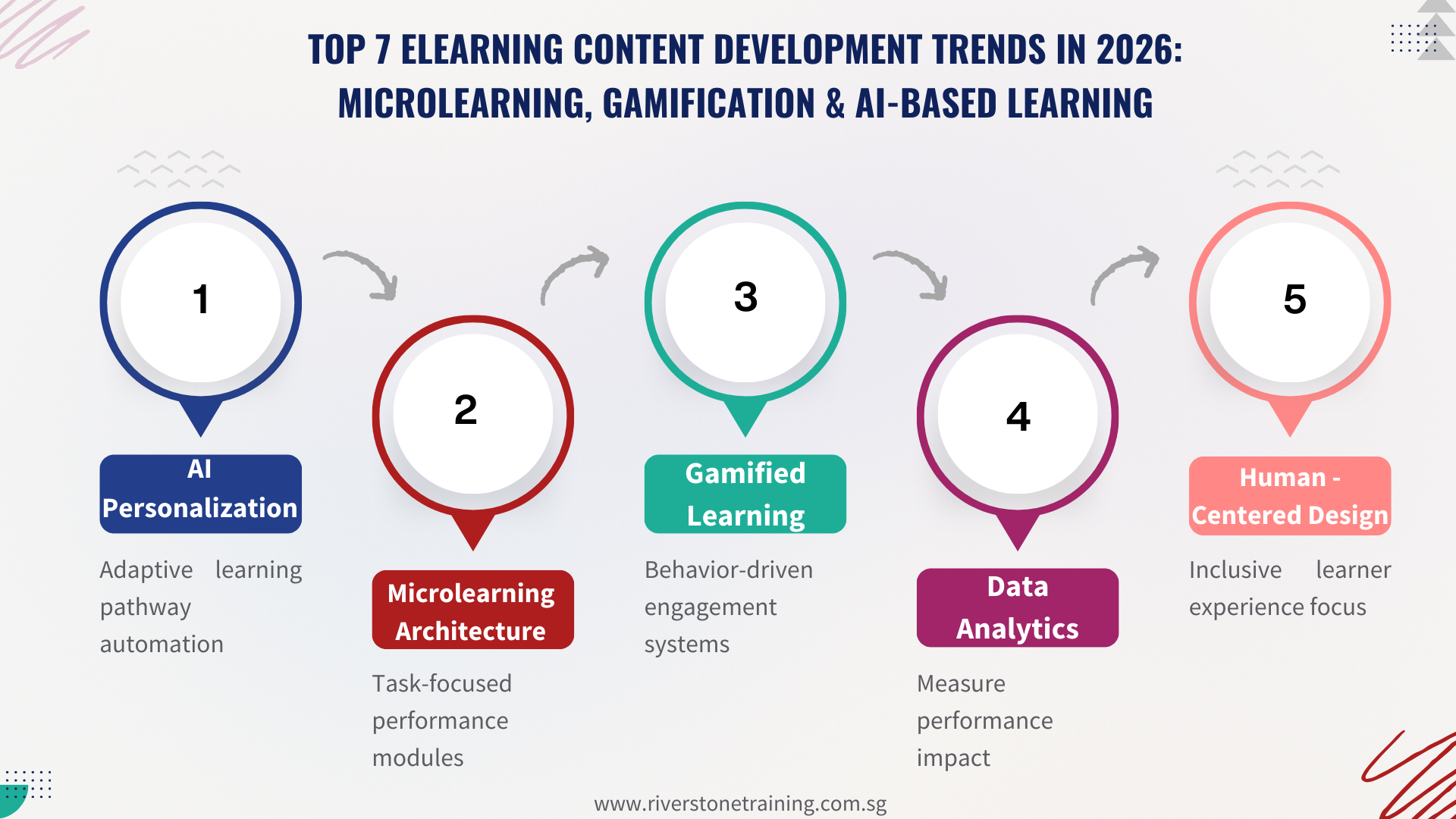
1. Artificial Intelligence-based Learning Systems
AI is not a far-fetched reality in the field of corporate training. By 2026, AI is integrated directly into the Elearning Content development processes and acts both as a production factor and a learner experience. Companies that used to rely on fixed modules now implement dynamic systems that have the ability to analyze behavioral information and react in real time.
The current AI engines compare the performance of assessments, frequency of interaction, time-on-task rates, navigation rates, and even consistency of decisions in the simulation. Rather than placing uniform courses in specific departments, systems create custom learning avenues that are specific to areas of individual weaknesses. There are content sequencing, reinforcement intervals and difficulty levels that are dynamically adjusted on the progress of the learner.
In the development sense, AI makes things more efficient. Scriptwriting, automatic speech synthesis, semantic translation processes, tagging of content, and situation-building solutions decrease the time. But the most disruptive one is predictive analytics. Intelligent dashboards detect potential areas of competencies lapses prior to their conversion into performance failures.
As an illustration, when the frontline managers exhibit deteriorating performance in conflict resolution exercise, the system may introduce specific reinforcing modules in advance. When sales representatives fail to perform in the negotiation branches, there should be micro-intervention that could be initiated automatically. It is this predictive ability that helps to convert the reactive correction-based Elearning Content development to proactive management of capabilities.
The outcome is better retention, faster skills development and better ROI quantification. Organizations cease the anecdotal impact of training to the data-driven workforce optimization.
2. Microlearning as a Performance Architecture
Microlearning has evolved to become a design principle of Elearning Content development. No longer is it merely a question of summarizing content in the form of shorter videos or smaller modules. Rather it is a structural reconsideration of how learning can be aligned with the real-world performance instances.
When working in a fast-paced and hybrid work environment, employees can hardly spend hours in continuous training. The solution to this limitation is microlearning, which provides brief targeted knowledge segments in relation to particular tasks or decision points. Every micro-unit concentrates on one learning goal and synchronizes exercises of direct application.
This method is highly encouraged by cognitive science. Spaced repetition boosts long term memory. Practice of remembering enhances recall mechanisms. The decomposed complex competencies in the form of focused skill clusters can also be used by organizations to reduce cognitive load and enhance transfer efficiency.
Online learning also fits perfectly into online processes. Just-in- time modules can be accessed by employees in time, prior to important presentations, regulatory reviews, client negotiations, or operational audits. This makes the Elearning Content development more of an integrated performance support system as opposed to an isolated knowledge event.
By being planned carefully, microlearning helps to reduce onboarding times, become more agile, and become more confident in a high-stakes situation.
3. Gamification through Behavioral Intent
In 2026, gamification goes beyond mono-dimensional approaches to engagement. In sophisticated Elearning Content development, gamification is strategically congruent with competency advancement and quantifiable mastery.
Modern systems do not just award points because of completion, but use them to assess the quality of decision in a branching simulation. Progression status is given to learners according to the applied reasoning and accuracy in behaviors. There is skill mastery shown by leaderboards and not passive involvement.
This change is based on the psychology of motivation. Learning trajectories enhance the sense of autonomy, mastery and quantifiable development. Gamified platforms, which in combination with AI analytics can adapt challenge levels and dynamically adjust them to ensure that participants are neither bored nor overly engaged in the challenge without experiencing cognitive load.
Gamification, therefore, becomes more of a form of entertainment to a form of structured performance rehearsal. It promotes habitual training, develops resilience and intrinsic drive.
4. Evidence-Based Instructional Design
Elearning Content development strategy has taken the center stage due to the role of data analytics. Organizations will not just base their post-course survey or anecdotal feedback on it, but they will analyze heatmaps, drop-off points, scenario results, navigation paths and patterns of behavior.
These observations indicate areas of conflicts in course design. In case learners constantly stop at certain stages, the information might need to be reorganized. In case the evaluation of data shows that there is a general misunderstanding, the reinforcement strategies may be employed.
Instructional design based on data allows the refinement. Online education becomes interactive and not fixed. With time, the organizations are able to come up with performance intelligence frameworks that maximize the learning impact at a more accurate level.
This level of analysis builds up confidence by the executives. The investments in learning are based on quantifiable behavioral evidences and not on indicators of subjective engagement.
5. Immersion and Scenario-based Simulation
All the Immersive technologies like augmented and advanced simulation environments are being integrated into the development of Elelearning Contents especially in high-risk industries.
Healthcare practitioners train emergency operations in virtual settings. Aviation crews practice crisis management situations in virtual environments and only after that, they move to the actual cockpit. Banking institutions utilize simulations of fraud detection which simulates complicated regulatory scenarios. To minimize accidents that occur at the work place, manufacturing companies conduct simulation of safety-related functions.
Though immersivity in development demands more investment, the effects of immersivity in transfer of skills and reduction of risks justify the cost. Experiential learning enhances confidence on decision making and minimizes variations in performance.
The Elearning Content development through simulation is a bridge between theory and practice where employees are able to exercise under pressure without operational implications.
6. Life-long Learning Communities
Old school corporate training was based on a one-off workshop, a yearly compliance course or a refresher course. Conversely, the current Elearning Content creation facilitates sustained learning communities.
Learning experiences are not limited to the course completion with reinforcement nudges, contextual micro-experts, coaching integrations, and loops of performance analytics. The employees are in constant learning development as opposed to infrequent learning.
This strategy is in line with the fast technological change. The skills that are applicable now might be obsolete in a matter of months. Ongoing ecosystems also make workforce capability up to date and flexible.
Reinforcement systems fight the decadence of knowledge and maintain behavioral change. Organizational culture involves continuous development and not compliance.
7. The Principles of Human-Centered Design
Nevertheless, effective Elearning Content development is also essentially a human activity even in the context of technological sophistication. Emphasis should be on the automation as an extension of empathy, and not the other way round.
Design of user experience is less focused on visual complexity, closed-mindedness, and exclusivity. The platforms should be able to support multilingual learners, different cognitive preferences, and different degrees of digital literacy. The design of the navigation is easy to use and makes the navigation more entertaining.
Real-life workplace situations are more relevant. Psychological safety promotes risk-taking and putting things into practice. Inclusive design means that it is represented and not biased to a culture.
By considering human-centered design it is possible to strengthen trust and involvement so that the technological progress may contribute to true capability development.
Deep Focus: Microlearning and AI as the Key Transformation Drivers
Although there are several trends which affect the development of Elearning Contents, the integration of AI and microlearning architecture are the most disruptive factors that will influence the development of 2026 and beyond.
The use of AI brings about intelligence, flexibility, and foresight. It makes digital courses become reactive ecosystems that change depending on the behavior of the learner. Rather than generic modules, organizations implement customized learning experiences based on competency spots of individuals.
Microlearning brings forth agility and accuracy. It adopts short, work-focused courses by which it addresses the acquisition of knowledge and the real-time performance requirements. The workers are assisted at the point of need which makes them more confident and lessens mental load.
Combining AI and microlearning allows the formation of a synergetic framework. Technology The AI finds skill gaps using behavioral analytics. Microlearning provides interventions that are specific. This synergy saves on time wasted training, fast-tracks competency development and strengthens ROI that can be measured.
Organizations that use the two strategies have better retention rates, reduced on-boarding time, increased compliance accuracy, and improved productivity rates. Learning would be proactive, embedded and constantly optimized.
Learning Leader Strategic Implications
The revolution of the Elearning Content development has a profound strategic repercussion on the Chief Learning Officers and the HR executives. Digital learning should be embedded in the enterprise planning processes but not as a separate activity.
The learning strategy must be in line with the workforce planning, digital transformation roadmap, and succession management structures. Learning analytics data must be used in executive decision-making. Forecasting should put into consideration the new requirements in terms of skill that will arise due to automation and market changes.
The decisions made when it comes to investment should focus on scalability, interoperability as well as long-term adaptability. Platforms ought to be interconnected with HR solutions, performance dashboard, as well as enterprise data architecture.
Leaders that adopt Elearning Content development as strategic infrastructural development and not content generation enjoy competitive advantage.
AI-Integrated Elearning Content Development Organizational Readiness
Artificial intelligence has transformational potential, but the successful application relies on the organizational preparedness. Most companies spend on AI tools without integration with strategic learning architecture. Consequently, automation is disjointed instead of disruptive.
In order to use AI to its full potential in the context of Elearning Content development, organizations should consider such pillars:
1. Information Infrastructure Maturity
AI-based personalization is based on quality high-structured data. Behavioral analytics, skills taxonomies, performance measures, and competency models have to be captured in learning management systems. The AI recommendations are not consistent or inaccurate without clean data architecture.
The proactive organizations will incorporate the LMS platforms in the HRIS, performance management systems and operational dashboards. Such a data flow at the ecosystem level allows predicting, not only a descriptive reporting.
2. Standardization of Skills Taxonomy
Competency mapping is structured in AI systems. Skill frameworks should be defined by the organizations in a way that the roles are connected with measurable competencies. As the learning goals are in line with business-oriented capabilities, adaptive learning trajectories can be created by AI engines strengthening the capability gaps.
Such precision brings the development of Elearning Content to a higher stage of content distribution to capability engineering.
3. Governance and the use of AI Ethically
With AI affecting the choices in learning, governance structures are necessary. Algorithms recommendations with transparency make things fair, particularly where the results of training affect the promotion or performance appraisal.
Ethical management should deal with privacy of data, reduction of bias, and understandable artificial intelligence reasoning. Digital learning systems being responsibly integrated create a stronger trust.
The Intelligent Learning Architecture Economics
On top of the pedagogical importance, AI-based Elearning Content development poses quantifiable financial benefits.
Reduced Development Time
The assistance of AI in scripting, translation, localization, and voice synthesis decreases the production cycles. What used to take weeks of manual labor is now able to be done much faster without affecting the quality.
Lower Redundancy Costs
The predictive analytics detect overlapping training programs. Organizations do not replicate content libraries and implement specific reinforcement modules only on demand, instead of duplicating them across departments.
Investment Allocation based on performance
Traditional training budgets have been known to base their resources on past practices. AI dashboards also report real-time ROI analysis and determine what modules are associated with a productivity increase, sales growth, or reduced errors.
Changes in investment shift of volume training to impact based learning strategy.
Microlearning Architecture as a Strategy of Operation
Micro learning can often be confused with the delivery of short-form video. As a matter of fact, microlearning as an architectural design philosophy is considered as an advanced Elearning Content development.
Task Centered Learning Design
In contemporary organizations, the abstract competencies are no longer the basis of learning programs. Rather, they model Elearning Content development in direct relation to working processes and actual performance situations. Instead of providing a general and generic course like customer service excellence, the instructional designers are dividing that concept in very specific and task-focused competencies that are representative of the true needs in the workplace. These skills are then converted into disciplined learning units that reflect on real activities by employees.
To use the objections as an example, the management of the objection is considered a specific skill that needs a particular framework of communication, methods of emotional intelligence, and a model of responding to the objection. The control of escalations would be another learning process that would cover the psychology of conflict resolution, the limits of authority and risk mitigation strategies. The methods of cross-selling are based on behavioral stimulus, consultative selling approach, and value articulated model. The modules of complaint de-esalation target the modulation of the tones, empathy statements, and predetermined recovery scripts.
All these micro-modules are also mapped consciously to a specific performance moment of the employee workflow. This task-oriented structure will enable the learners to receive accurate instructions just before or even in the midst of doing tasks. This consequently changes Elearning Content development based on knowledge broadcasting to performance enablement. Learning is integrated into operational reality as opposed to being distinct.
Cognitive Loops of Reinforcement
The developments of neuroscience have played an important role in the development of Elearning Content development strategies. Studies have always shown that it is distributed learning and not massed learning that enhances long-term memory consolidation. Microlearning facilitates this by allowing structure repetition through time as opposed to exposure in a single instance.
Spaced repetition will make sure that the information is repeated at intervals that are well timed, which strengthens neural pathways and lowers memory loss. Retrieval practice enhances the cognitive recall process in which learners are expected to actively recall information as opposed to passively re-reading. Application at once helps to bridge the gap between theoretical knowledge and behavioral implementation thereby enhancing the chances of the knowledge being converted to procedural memory. Contextual reinforcement also reinforces retention by delivering learning contents in the real world situations that resemble real workplace conditions.
With the application of these principles of neuroscience in the development of Elearning Content, organizations can inhibit knowledge attrition and promote sustained mastery of skills by a high margin. Learning is no longer a short-term intervention but rather an ongoing process of cognitive reinforcement which is congruent with the human memory architecture.
Agile Update Capability
Micro-modules are convenient to update as compared to long-format courses. A change in regulations or the development of products can be updated in individual units without having to redesign whole curricula.
This flexibility helps a great deal in the rapidly developing sectors like fintech, healthcare, and cybersecurity.
AI + Microlearning: The Adaptive Feedback Loop
The most radical innovation in the Elearning Content development is integration of AI analytics with modular microlearning architecture.
This forms a loop process of constant adaptation:
- AI measures performance statistics.
- The gap in skills is detected automatically.
- Interventions of microlearning are activated.
- Improvement is assessed using behavioral measures.
- Recommendations are recalibrated in the system.
This is a closed-loop model, which transforms training into a periodic training event into a continuous capability refinement system.
Organizations implement precision reinforcement instead of having quarterly compliance modules. Learning is provided to employees at the time when it is needed.
The result is:
- Reduced cognitive overload
- Faster onboarding cycles
- Increased performance levels.
- Better knowledge transfer.
- Implications of Strategic Leadership.
The strategic implications of the content development of Elearning go way beyond the instructional design teams. Digital learning environments are impacting the decisions made by an enterprise, human resource planning, and competitive stance. Consequently, no longer is the leadership engagement optional, but it is necessary.
Transforming HR Function into Strategic Asset
Training in corporations has traditionally been considered an administrative operation that was handled strictly by the HR departments. But today, the digital learning is coming into the core business infrastructure. It has such effects as an impact on operational performance, technological integration, compliance risk, and financial forecasting.
There is a growing merging of Chief Learning Officers and Chief Information Officers to make sure that adaptive learning systems are supported by AI infrastructure and data integration. They collaborate with Chief Financial Officers to put in place quantifiable ROI frameworks that warrant learning investments in terms of real performance deliverables. The cooperation with Chief Operating Officers will make sure that the development of Elearning Content adheres to workflow efficiency, quality control, and productivity targets directly.
This cross-functional alignment makes learning an aspect of strategic support becoming an integral part of enterprise architecture.
Competitive Differentiation Learning
Market competitiveness in knowledge-based economies depends directly on how quickly the organization can develop, implement and enhance skills otherwise known as skill velocity. Firms that are able to upskill their workforce quickly outperform their competitors in the areas of innovation, flexibility and responsiveness to customers.
The AI-assisted Elearning Content development increases capability deployment in the geographically distributed teams. Companies can also roll out new competencies in real time as the market conditions change as opposed to using the traditional annual training cycles. Such agility enables the businesses to be proactive to regulatory change, technological shock and changing customer demands. The process of learning thus becomes a process of strategic differentiation and not a compulsory thing but an obedience process.
Measuring Long-Term ROI in 2026
Conventional learning indicators were concerned with completion rates. Contemporary Elearning Content development needs highly sophisticated ROI modeling.
The important dimensions of measurement are:
- Behavioral Change Metrics
- Monitoring frequencies of applications in practice.
- Performance Impact Indicators.
- Examining productivity, errors, and revenue contribution.
- Time-to-Competency Reduction
- Onboarding acceleration using AI adaptive learning.
- Correlation of Retention and Engagement.
- Evaluating the role of the accessibility of learning in employee retention.
Using analytics to correspond to the operational KPIs, organizations are able to show that digital learning is a direct contributor to the increase in revenues and strategic resiliency.
Addressing Implementation Issues
Although these advantages are evident, there are challenges to modernization in development of Elearning Content in organizations.
Change Resistance
The workforce used to the traditional paradigm of learning might be initially unsupportive of AI-based personalization. Communication and implementation in phases are a way to minimize friction.
Over-Automation Risks
Instructional design should be improved, but not be substituted by strategic thinking. Ethical compliance and contextual relevance is maintained by human control.
Disjointed Technology Systems
Old LMS can be non-integrative. The possibility of strategic modernization of the platform is usually needed to realize the potential of AI.
Creating a Future-Ready Culture of Learning
Although technology is transformative in the development of Elearning Content then digital tools do not ensure success. Impact sustainability requires cultural congruency and management support. In the absence of a culture that encourages the pursuit of constant learning, even the most sophisticated platforms will fail to gain adoption.
Organizations need to promote continuous learning attitudes where skill training is perceived as a continuous professional obligation and not a massive need that arises at certain intervals. Psychological safety is necessary, as they need to know that they are not afraid of skill shortages and be comfortable admitting them. The support of the leadership strengthens the validity of the digital training programs, which means that the attendance at the learning process is not a mandatory task of the administration, but a part of the strategic approach. Open-minded performance feedback systems also contribute towards development by bridging between training involvement and quantifiable enhancement.
Once the development of Elearning Content is based on the organizational culture, this process becomes adopted naturally. Studying turns into routine working processes rather than being viewed as an outer necessity.
The Human-Centered Design in the Advanced Ecosystem
Despite the further sophistication of AI and automation, empathy will continue to play a primary role in successful Elearning Content development. Human-centered design will make sure that the technological progression does not make the experiences of the learner complex.
The intuitive navigation minimizes friction and the cognitive load that may occur to the learner and also enables the learner to concentrate on the content and not the interface functionality. Inclusive language avoids discriminative language and fosters mental ease. Different scaffolds are available to the learners who are either visual, auditory, cognitive, or motor. Simulations in real working environments capture real life issues as opposed to abstract case studies which reinforce learning transfer of the simulated task to the real environment.
Compliance on accessibility also implies fair participation among the different groups of employees. Advanced digital ecosystems need technology to not only support the human growth but also make matters simpler and clarify instead of bombarding the learners with a plethora of features or a high level of design sophistication.
The Future Outlook Beyond 2026
With the increasing pace of the digital transformation, the Elearning Content development is likely to be even more entrenched in the enterprise systems. The new ecosystem can involve live skill certification systems that have blockchain validation, which will provide transparent and unalterable credential records. Behavioral analytics can be used to offer personalized coaching through AI-based mentoring bots. Voice recognition learning devices might be used to provide hands-free knowledge availability when executing the operating duties. The skill gaps can be predicted by workforce planning dashboards that automatically initiate specific learning flows.
Learning architecture will serve as the brain of organizational capability in this new scenario. Instead of being present as an independent training department initiative, it will be an integrated intelligence layer that continuously tracks, forecasts, and optimizes the performance of the workforce.
Radical Deep Focus: AI as a Strategic Learning Intelligence Layer
Artificial intelligence cannot be perceived as the tool of automation. In high-end Elearning Content development, AI serves as an intelligence layer that will be overlaid on the whole learning ecosystem.
It carries out three strategic functions:
- Diagnostic Intelligence
Scans work force capability gaps by department and region. - Prescriptive Intelligence
Suggests specific microlearning units in accordance with personal skills gaps. - Predictive Intelligence
Predict competency risks in the future by using industry trends and shifts in the organization.
This is an elevated strategy that converts digital training to a performance command center.
Extended Deep Focus: Knowledge Infrastructure as Microlearning
Microlearning is moving past content segmentation. It is turning out to be the organizational backbone of the current Elearning Content development architecture. In high-tech systems, micro-modular design allows introducing new knowledge into the operating system in a very short time without having to re-design the whole system. It is possible to make changes to individual modules to introduce new regulatory requirements, product knowledge, or operational procedures instead of redesigning whole courses.
Reinforcement cycles help in keeping the mind constantly active and stopping the loss of knowledge. The intelligence personalization motors create modular routes in real time, and according to a student profile. Interoperable modules can be used in scalable global training implementation as they can be localized without the need to re-architecture the underlying content.
This infrastructure-based strategy is something that separates the progressive organizations and the ones who introduce superficial digital upgrades. Rather than considering microlearning as shorter content, leaders view them as architectural approaches, which facilitate agility, scalability, and continued performance alignment.
Conclusion
The way forward on corporate training in 2026 points at strategic shift in Elearning Content development. The personalization powered by AI, microlearning architecture, advanced analytics, immersive simulation, and human-centered design are all elements to redefine digital learning strategy.
Nevertheless, the successful implementation involves integration and not the superficial adoption of trends. Organizations need to integrate innovation to quantifiable business goals and performance indicators.
Elearning Content development When utilized strategically, Elearning Content development transforms into a performance engine. AI provides intelligence. Microlearning provides agility. Information guarantees responsibility. The human-centered design maintains the interest and trust.
The digital learning in this new era is not merely about disseminating information. It is concerning the creation of adaptive ecosystems which steadily build workforce capability, enhance organizational resilience, and propel sustainable competitive advantage in the fast-changing global economy which is becoming very complex.