Professional Development
In today’s fast-changing markets, with digital disruption and increasing regulatory complexity, it’s not only products or capital which make or break whether an organisation can remain competitive; it’s the quality of knowledge their people bring to every boardroom, deal and strategic decision. PD has transitioned from being an HR practice to a business need. The finance professional, business leaders and corporate decision makers now know that they must invest in workforce learning, but how deep in which disciplines?
In Asia and around the world, businesses are increasingly realising that they have the best long-term competitive edge when they have skilled, knowledgeable, and analytical employees. The organisations that are successful today have one thing in common – they see employee learning as a value driver and not a cost centre. All the way from the basics of corporate finance to the advanced knowledge of investing, the field of corporate education is changing dramatically — and the companies that adopt it first will be the most ready for the future.
Why Professional Development Is No Longer Optional
Professional development in the corporate world has largely been informal for decades, as employees have been mentored on the job, attended occasional seminars and gained experience gradually over time. This no longer works. The world of business is demanding new levels of technical expertise, multi-challenge business literacy and the capacity to evaluate intricate financial data on the spot. The basics of finance are common among all employees, no matter their role in treasury, risk, investor relations or strategy.
Structured L&D programmes are proven to give companies an advantage in almost every measurable way, and not just in terms of higher recruitment retention figures, but also in revenue growth, innovation and much more. The Association for Talent Development estimates that companies that invest in full training programmes generate a 218% increase in income per employee and a 24% increase in profit margin over companies that invest less in training. This is not about marginal gains; these are organisational changes and differences.
The numbers don’t lie for HR teams and business leaders who are making the case from within. Structured finance fundamentals training provides employees with a common analytical toolbox and eliminates the need for expensive mistakes in structuring decisions, and increases institutional confidence to pursue growth opportunities that may be too tricky to analyse.
The Demand for Finance Literacy Across All Business Functions
A major revolution in corporate talent in the past year has been the demand for more finance literacy outside of finance. In today’s world, product managers must make business cases. It’s essential that operations leaders know what ROAS is. Marketers are being called to prove the spend with data-based attribution models. This is a space where knowledge of finance is not a specialist area, but a universal one.
This reality has created enormous demand for corporate finance learning that speaks to professionals from diverse functional backgrounds. The best programmes are delivered through a focus on relevance to the practice of the financial statements and the real-life decisions of leaders on a daily basis.
Meanwhile, companies can’t afford to ignore the development of their own finance personnel. Trained a decade ago, accountants, analysts and finance managers may be using frameworks that are no longer reflective of market realities. Structured finance for professionals courses that address modern analytical techniques — including scenario analysis, integrated financial modelling, and capital structure optimisation — help finance teams stay sharp and commercially focused in a rapidly changing landscape.
Those who see finance education as a stand-alone event are missing out on performance – the experts who will be successful in the long term are the ones who approach learning as a permanent activity and not a one-off.
Financial Modelling: The Language of Modern Business Decisions
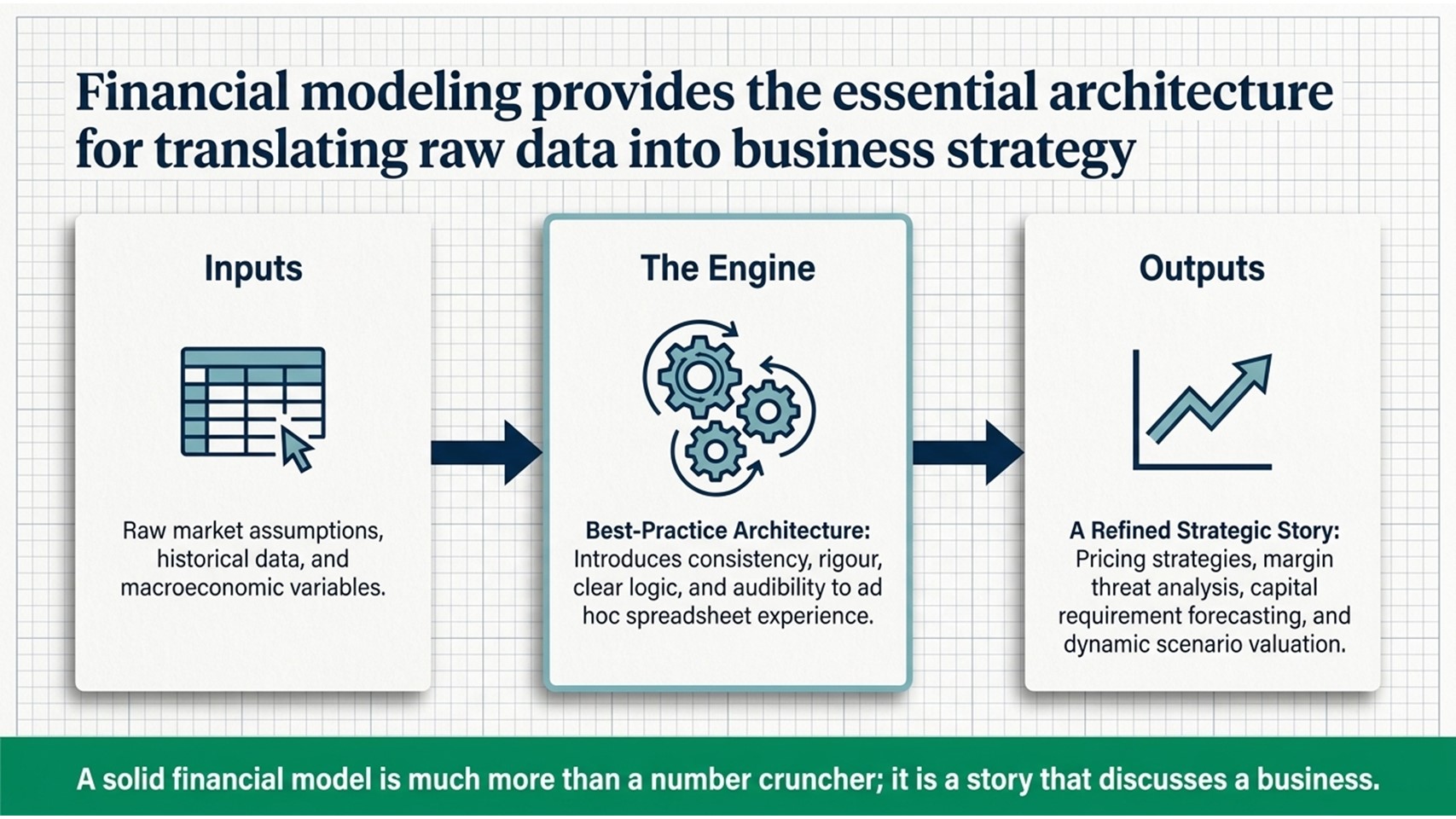
Financial Modelling is one of the most important skills, if not the most important, to increase in strategic significance in the last decade. The skills of building and analysing financial models have become an essential competency in business, and not just a niche speciality for banks, private equity firms, infrastructure, health care or technology companies.
A solid financial model is much more than a number cruncher. It is a story that discusses a business and how prices will be expected to rise, what may be the threats to erode margins, how much money is needed to finance the subsequent steps in development and what a company can be worth in several circumstances. As a result, investment professionals, corporate finance teams and strategists alike are spending significant resources on investment analysis modelling to develop in-house capabilities.
A focused business modelling course brings an element of consistency, rigour and best-practice architecture to a set of years of ad hoc spreadsheet experience. People trained to use a clear and logical base to create models will produce not only a more accurate model, but they will also make it easier to audit, update, and present to stakeholders.
For teams that must make decisions that can have a significant impact on their budgets quickly and effectively, the availability of comprehensive financial decision tools training is a real competitive edge. The time that can be saved in doing due diligence, developing scenarios, and presenting to the board can be substantial, and the value that can be gained from well-designed models often shows opportunities and risks that other simpler models would not have shown.
Advanced programmes in modelling techniques workshops focus on advanced programmes, involving experts from the field who discuss real-life case studies, test their modelling assumptions and share expert practice for tackling the more difficult aspects of building a model. Whether through open-enrolment programmes or tailored corporate finance modelling engagements, the investment in this skill set pays dividends quickly.
Project Finance: A Specialised Discipline for Infrastructure and Capital-Intensive Sectors
Project Finance is one of the areas of finance which demands so much special skill. Project finance is a method used for infrastructure projects, energy projects, transport, utilities and big real estate deals for analysing and structuring deals where the repayment of the debt is mainly going to be done through the cash flows of the project itself. It is a field in which you need to master the analysis of financial data, knowledge of legal structures, risk allocation, regulatory aspects, and the process of negotiating objectives with multiple stakeholders.
For professionals entering this field, a grounding in project finance basics is essential. The analytical building blocks for all of the more advanced work are understanding the difference between recourse and nonrecourse financing, the use of special purpose vehicles and the coverage ratios that are essential to all special purpose vehicles, such as the DSCR and LLCR.
As governments across Southeast Asia continue to invest in large-scale public infrastructure, the demand for professionals with genuine expertise in infrastructure finance has never been higher. This niche skill-set is in demand by banks, multilateral development institutions, project developers and government agencies.
Structured project funding training provides the tools and techniques to help analysts and advisors through compliance and financing these transactions – from feasibility to financial close and into operations.
Employers, particularly public sector, are looking for the ability to conduct detailed capital project analysis is increasingly valued by both public and private sector employers.. In the same way, practitioners who are able to initiate a project evaluation process for a project based on quantitative analysis and qualitative judgement contribute a lot to the organisations that invest in their development.
Private Equity and Alternative Investments: Building Expertise in High-Stakes Capital Allocation
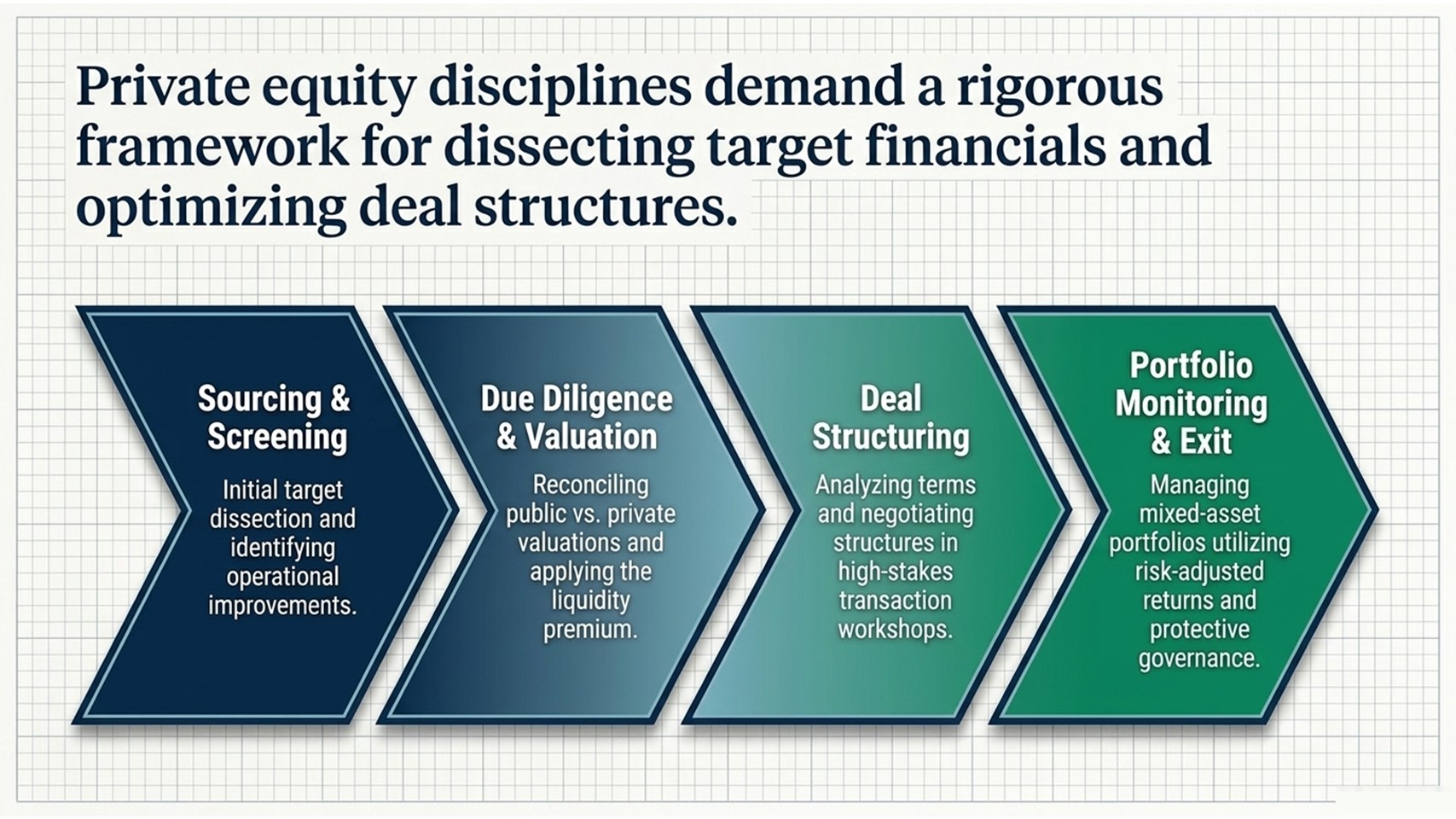
In finance, and in particular private equity, it is believed that one of the most challenging and intellectually demanding fields is the business. They need to be able to dissect a target company’s financials, understand the deal terms and structure them and identify improvements to the business, as well as to manage the portfolio, all in one.
A well-designed private investment course covers the entire spectrum of the private investment process, from deal sourcing and initial screening, through due diligence, to the investment committee presentation, portfolio monitoring and exit.
A successful transition can be significantly facilitated for professionals with capital markets backgrounds through focused capital markets training that brings together the concepts and strategies from the public markets to the private equity platform. The knowledge of how the public and private valuations differ, how the liquidity premium is incorporated in valuation, and how the different deal structures will impact the returns can be very helpful and can be taught very systematically.
The PE fundamentals course format is particularly valuable for professionals who are newer to the asset class. Experienced practitioners looking to refine their deal negotiation skills will benefit from the case-study depth of an investment deal workshop, where real transactions are dissected and alternative structuring approaches are debated.
Professionals responsible for broader portfolio strategy — managing a mix of assets across stages and sectors — will find that structured education helps them think more rigorously about diversification, risk-adjusted returns, and the governance frameworks that protect investor interests.
Business Valuation: The Cornerstone of Sound Financial Decision-Making
The issue of value lies at the core of most large-scale corporate ventures, be it an acquisition, divestment, fundraising round, restructuring, or succession planning. What’s the value of this business? How certain are we that that’s the right assessment? These are questions that require both technical expertise and good judgment, and prove the value of business valuation as one of the most coveted skills in corporate finance.
If a professional can establish a solid foundation of business valuation basics, he or she can meaningfully answer these inquiries, including what assumptions lie behind the various methods, the situations in which each method is best used and the reasons for differences between the methods.
A company valuation course is an excellent resource for corporate development teams looking to engage in M&A transactions with speed and confidence.
HR professionals and business leaders should be mindful of the value aspects that can be applied in various areas of business, such as strategic planning, investor relations, and corporate governance. A valuation training program open for professionals from all disciplines makes this information available to everyone in the organisation, enhancing the quality of decision-making.
Targeted asset valuation training is ideal for industries that have a substantial tangible or intangible asset base. When these areas are supplemented by financial analysis and valuation skills, they are more able to assess the allocations and interactions with external parties.
In-House Training: Tailoring Development to Organisational Needs
Although open-enrolment programmes provide a great deal of exposure to best practices, the best development programmes are often those based on their own unique business context, culture and priorities. In-house corporate training brings the training to the organisation – the content can be tailored to the company’s own financial models, deal experience, internal language, etc.
A targeted on-site leadership training program is more than just about training skills; it helps develop a common language, common best practices and common goals within teams.
For organisations scaling rapidly or undergoing structural change, targeted corporate skill training initiatives help ensure that capability keeps pace with organisational ambition. Proactive organisations close skills gaps systematically through structured internal training workshops tightly aligned to real business challenges.
The most forward-thinking HR teams are moving toward comprehensive business training programs that map learning pathways to career stages. Combined with thoughtful workforce training solutions incorporating multiple modalities — facilitated workshops, coaching, and digital content — these programmes create sustained capability uplift rather than one-time skill refreshes.
The Rise of Digital Learning: Accessible, Scalable, and Effective
Organisations’ development delivery has transformed as a result of the transition to digital-first learning.A digital-first approach to education has changed how organisations can provide development at scale. It was a solution that was needed, but for many organisations became a desired solution as well because it provided more flexibility, less logistical overhead and the possibility to communicate with geographically dispersed teams without the limitation of physical presence.
A good digital learning experience is a well-designed pathway that includes a series of learning activities, case studies and knowledge checks. The investment in quality online education tools provides the framework through which corporate knowledge can be constantly added and updated, a tool that is able to hold multiple content types and track progress.
Digital course development is a strategic investment for organisations developing and/or expanding their internal learning capability. Digitalising institutional knowledge into structured content creates a scalable learning that can be used to onboard new employees and for promotion.
The range of e-learning solutions has grown by leaps and bounds, opening up a myriad of possibilities of approaches to meet the complexity of the content and the tastes of the audience. Previously too technical to deliver in the digital space, finance topics can now be taught effectively — if the training content design is grounded in sound instructional methodology and real subject-matter skills and experience.
The latest generation of interactive learning tools allows learners to engage with simulated financial models, work through decision-making scenarios, and receive immediate feedback on their analytical choices. This type of interactive digital learning is true innovation in the scaling of professional skills training, especially in finance.
Building a Culture of Continuous Learning
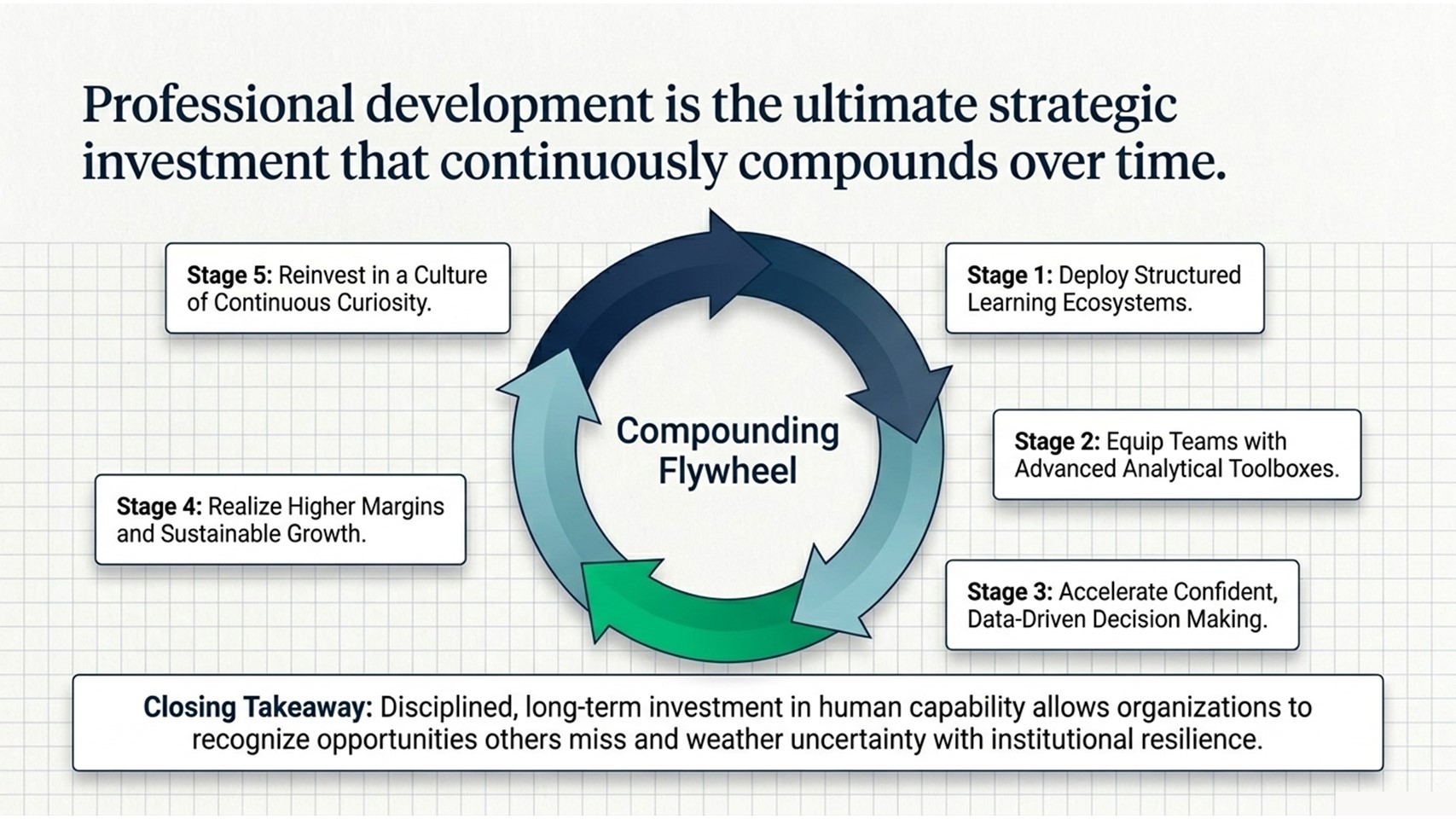
Finally, the organisations that reap the most benefits from professional development activities are those that have developed a true culture of learning. In these organisations, learning isn’t something that just occurs once a year; it’s the way that people work, how even managers coach people, and the way that people are led within the organisation, they’re led to be curious.
This culture takes action; management that fosters psychological safety for employees to admit they don’t know the answer, and performance management that seeks to grow new skills and capabilities. Career progression pathway, business finance education will make the employees understand the impact of investing in education on their career.
For financial professionals, a structured finance skill development program is a sign of the organisation’s commitment – that the organisation recognises its financial capability as a strategic investment for the organisation and is willing to make the investment. This signal has a direct impact on the ability to attract and keep highly talented individuals in an environment of seeking new skilled workers.
Conclusion: The Investment That Compounds
Financial professional development isn’t a luxury; it’s a business need. In a business world where analytical skills, financial acuity, and niche expertise truly make a difference, it is the companies that take a systematic approach to the knowledge of key stakeholders that will weather the storm of uncertainty, recognise and seize opportunities that others don’t, and develop the institutional skills necessary to sustain long-term growth.
There has never been a time when there is a greater variety of choices and access to corporate education. Whether it’s structured open-enrolment programs in financial modelling, project finance, private equity and business valuation, in-house programs or high-tech, personalised digital learning platforms, the options available to HR teams and business leaders today make it truly achievable to create world-class finance capabilities in virtually any organisation, no matter its size and location.
There is no access and no resources that differentiate the organisation that can achieve this potential from that which cannot. The clarity of strategic intent and the commitment to making employee development the investment that it is. Just like in finance, the reward for long-term, disciplined investing in good business is far greater than any other approach in business.