
Case Study: Real Estate In-House Training Services Strengthening Property Knowledge and Investment Decision-Making
Background on Case Study Real Estate In-House
A diversified company that has exposure to real estate investment and property related operations was in need to enhance internal real estate expertise in its finance team, investment team, asset management team, and the senior management team. The organisation possessed a combination of income generating property, development property and strategic real estate assets that became a bigger part of its total business and investment plan.
The rise in the rate and complexity of property related choices led the management to realise that the internal stakeholders required a more robust and coherent knowledge of the real estate basics. Although there was previous experience in property by some of the team members, the levels of knowledge were diverse and many people depended more on external advisors to provide them with property analysis and decision support.
To develop internal capacity and enhance the effectiveness of decision-making, the organisation contracted our Real Estate In-House Training Services to develop and implement tailor-made training programmes that would be in line with its portfolio, investment goals, and operations.
Issues and Challenges
The challenges that the organisation was experiencing also indicated that real estate training was required to be structured.
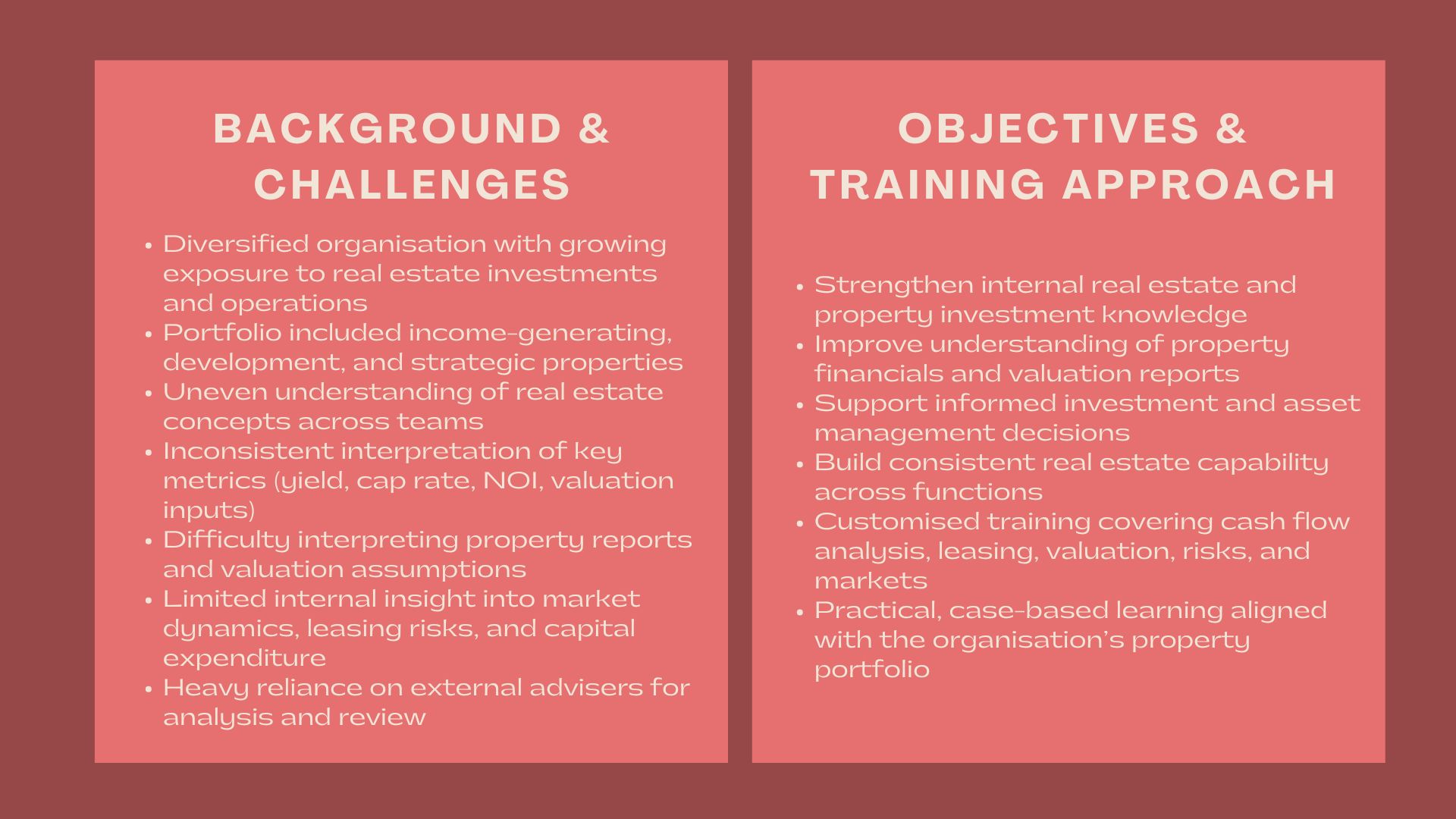
Inequalities in the knowledge of real estate concepts was one of the major issues. Different meanings of terms like yield, capitalisation rate, net operating income and valuation assumptions were usually interpreted differently by members of the teams who participated in property related decisions in making an inconsistency in the analysis and discussions.
The other difficulty was on the interpretation of property financial information. Although the external consultants provided property reports and valuation summaries regularly, internal stakeholders could at times find it difficult to be fully informed of the assumptions, risks, and sensitivity behind these reports.
Lack of knowledge on real estate valuation strategies and market forces was also limited. Respondents were conversant with high level concepts but were not clear on the effects of market conditions, lease format, vacancy risks, and capital expenditure requirement to property value and returns.
Further problems were risk assessment as well as investment decision-making. Management desired that teams should have greater knowledge of property-related risks, such as market, tenant, development, and financing risks to have better discussions on investment and governance levels.
Lastly, the organisation wanted to decrease excessive use of external advisors in making preliminary analysis and enhance efficiency of internal review and monitoring of property-related issues.
Objectives
The main aim of the engagement was to increase the internal real estate competence by in-house training on real estate that is customised.
In particular, the organisation was interested in:
- Enhance knowledge on essential real estate and property investment.
- Increase the effectiveness in comprehension of the property financials and valuation report.
- Greater support of informed investment and asset management decisions in real estate.
- Develop uniform real estate expertise.
- Enhance internal debate and monitoring of risks in relation to property.
The training should have been realistic, realistic and in co-ordination with the real estate portfolio and the strategic goals of the organisation.
How We Helped
Our in-house training of real estate business was structured and collaborative, based on the business model, business exposure and decision-making processes of the organisation.
The interactions started with a training needs assessment. We have collaborated with the key stakeholders to learn more about the property portfolio and investment strategy of the organisation as well as the challenges that were commonly faced by the internal team reviewing the real estate information.
On the basis of this evaluation, we have developed tailor-made training courses in major real estate areas. These were the basics of real estate, property cash flow analysis, leasing structure, operating expenses, capital expenditure related aspects, valuation-related aspects, and market dynamics.
We also talked about real estate investment and risk, and enabled participants to gain an insight into how quality of tenants, lease terms and market cycles, the structure of financing, and regulatory considerations affect the performance and value of a property.
There was a high level of focus on the practical application. Training was done by using real-life examples, simplified property modeling, and case based discussions which represented real life investment and asset management situations. The interpretation of property reports and valuations summaries was followed to give the participants confidence in the review of external advisor inputs.
The training programme was designed in such a way that it accommodated the various functions of the participants such as finance, investment, asset management, and senior management. This provided access and at the same time enhanced the adoption of a uniform perception of real estate concepts throughout the organisation.
The methods used to deliver training were also can be adapted to the operational requirements through a combination of on-site training workshops and online sessions. Engagement and practical learning was promoted by interactive discussions and scenario analysis.
We also used supporting material, reference guide and real estate frameworks as a means to reinforce learning and allow the participants to use the same after the training in order to support further decision-making and in-house discussions.
During the engagement, we collaborated with participants to clarify and answer questions, adjust content to the real estate context of the organisation.
Value Delivered
The case study provides an example of how the professional Real Estate In-House Training Services will enhance the property knowledge and contribute to the making of the decisions related to the real estate.
The engagement also helped to develop internal confidence in real estate analysis through customised and practical training, improve the knowledge of property valuation and risk factors, and have more successful conversations with external advisors as a result.
The in-house real estate training system that evolved on the basis of this engagement gave a sustainable base on capability development, better governance, and more viable management of the investments related to property.